
Mike Winger vs Vivek Ramaswamy: Winning for the Wrong Reason
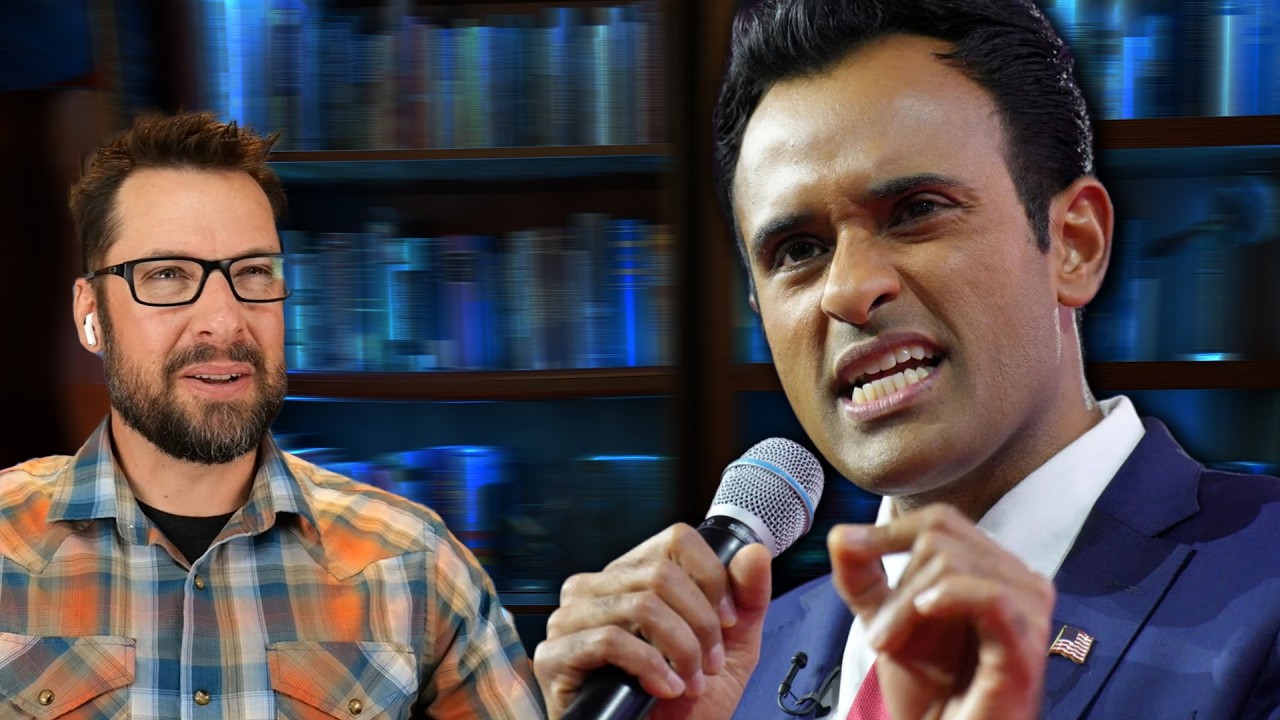
It is a fearful thing when YouTube influencer Mike Winger creates a video about you :) He has a well-earned reputation of thorough investigation and thoughtful refutation of anything that rises up against biblical Christianity. This week, he set his laser sights on Vivek Ramaswamy’s Hindu rendering of Jesus as a son of God who is one among many divine sons of God, and dispatched the view with his usual force of unassailable logic and charity. But despite the general excellence of his rebuttal, it’s worth pointing out that Mike Winger continues to propagate the less precise aspects of trinitarian doctrine and rhetoric that conflate Jesus’ sonship with his divinity.
Ramaswamy explained his views in the following way,
So I’ll be very honest — It’s not a hard question. So in our faith tradition, Jesus Christ is a son of God. I know that is different from saying he’s the son of God. But that is my view of Jesus Christ…one true God in many forms.
Mike Winger naturally took issue with this rendering of Jesus, and refuted it soundly enough in his typical, exemplary form. But like most trinitarians, his critique conflates two distinct ideas which Trinity Berean works hard to keep separate.
- Jesus is truly and uniquely God incarnated in human form.
- Jesus is the son of God.
For trinitarians, these two statements teach essentially the same idea, that Jesus is God. For a patternist, however, calling Jesus the son of God is a reference to his humanity, not (directly) his divinity. We affirm that Jesus is truly God; we simply deny that the title “son of God” describes this divine nature. Furthermore, we would see it as appropriate to also call Jesus “a son of God” in the same sense that a Christian is a son of God, because this shared relationship with the Father is what allows him to be considered our brother and coheir. Mike Winger, however, views this deeply biblical perspective as “high heresy,” due to the trinitarian habit of conflating Jesus’ sonship with his divinity.
How should a Christian respond to such a thing, or how should we think about such a thing? This is a way, to some, of honoring Jesus, of exalting Jesus…like I’m giving him high status. He’s a son of God. However, that is actually heresy to a Christian.
So it’s high status to be a son of God. However, when you’re talking about God in the flesh — about God, creator of all things, who comes in human form — when you talk about him and call him “a son of God,” it amounts to high heresy. So that’s something that a Christian cannot accept.
Now you can believe that. You can think that, and you’re free to do so. But that doesn’t make it compatible with Christianity, or okay… “A son of God,” that’s Jehovah’s witness theology, which are considered a cult and a false religion; they’re not Christianity. “A son of God” not “the son of God” in the biblical sense, where we’re referring to Jesus as God with us. God from all eternity, creator of all things, the second member of the trinity. When we say that, this “a son of God” thing becomes a problem. So Mormonism also rejects that. This is kind of a big deal. This is a die-on-this-hill kind of doctrine for Christians.
Winger then explained why he and other trinitarians view this as a die-on-this-hill kind of doctrine, through a common analogy which attempts to show that two different descriptions of God automatically means that two different gods are in view. I’ve already addressed this line of reasoning in the article, Must We Believe In the Trinity To Be Saved?, so I won’t go into it here. Instead, I’ll focus on the trinitarian claim that “referring to Jesus as God with us” is the “biblical sense” of the title “the son of God.”
Mike Winger vs Pattern Christology: The Weirdness of Trinitarian Titles
Trinitarians do something weird with the title “son of God” when they distinguish between “a son of God” (indefinite article) and “the son of God” (definite article). With most titles, the essential content of the title means the same thing regardless of the article in front of it. “A librarian” and “the librarian” are similar as titles, in that both are describing people who work in a building that houses books. The indefinite version describes the kind of role being discussed, whereas the definite version references a particular person who fills that role. However the content of the role “librarian” is the same in both cases.
In trinitarian theology, however, the meaning of the title “son of God” fundamentally changes between the indefinite and definite uses. As Mike Winger alludes to in the above quote, scripture does have a concept of many sons of God who all have a high status. According to this indefinite use, “a son of God” refers to a human being, created in the image and likeness of God, who is either a natural descendant of God (Luk 3:38), or is born again into God’s family (1Jo 3:1-9). However when it is used with a definite article, trinitarians want us to remove all of that human content, and import into the title “son of God” the idea of a relationship within the godhead between one divine person (God the Father) and another divine person (God the Son), a relationship which is wholly foreign to the content of what the same title means in its indefinite usage.
Of course it’s always possible that the same grouping of words can have two distinct meanings, and that scripture is using one meaning with Christ, and another one with the Christian. But Jesus and the Christian will often appear in the same context, being mingled together in a discussion of human sonship, as if we have the same shared familial relationship with the Father that he does. For example, Paul writes the following in Romans,
So then, brothers, we are debtors, not to the flesh, to live according to the flesh. For if you live according to the flesh you will die, but if by the Spirit you put to death the deeds of the body, you will live. For all who are led by the Spirit of God are sons of God. For you did not receive the spirit of slavery to fall back into fear, but you have received the Spirit of adoption as sons, by whom we cry, “Abba! Father!” The Spirit himself bears witness with our spirit that we are children of God, and if children, then heirs–heirs of God and fellow heirs with Christ, provided we suffer with him in order that we may also be glorified with him. (Rom 8:12-17)
Notice the familial language that Paul uses to describe the Christian’s new relationship with God, and with Christ. First, Christians are “brothers” together in the family of God, a status which Jesus extended to himself when he exulted in the shared familial relationship that we all have with the Father (John 20:17). Second, we are “sons of God” together with Christ, in contrast to slaves, which in both a Roman and Jewish context would reflect a difference in hierarchy and status within the family unit (Gal 4:1-5). Third, unlike Jesus we are adopted into the family of God. And fourth, we become heirs of God right alongside Jesus, as if we have the same sort of relationship with the Father that he does.
Far from driving a wedge between the sonship of Christ and the sonship of the Christian, Paul here draws us into the family of God, to give us the same status that is given to Jesus. Jesus certainly was included among those who lived by the Spirit according to his human nature, and who thereby would be considered a son of God. And he is shown to be our coheir of God’s possessions, with our shared inheritance flowing conceptually out of our shared sonship.
Colossians Forces Us Into This View
The Bible is replete with push-back against the trinitarian notion that the title “son of God” as applied to Jesus has a fundamentally different meaning versus when it is applied to Christians. To the contrary, from Genesis to Revelation there is a consistent, repeated idea that sonship is something that occurs within creation, when one person creates a new image-bearer, or adopts one of the same kind, instituting a new parent-child relationship within a family unit (Gen 5:1-3). The fact that Jesus is also divine — while important for other reasons — is irrelevant to understanding what it means for him to receive the title “son of God” in either its definite or indefinite form.
The issue is similar to the title “son of man” wherein the content of the title describes a descendant of Adam, and use of the definite article (“the son of man”) simply adds context which helps us to identify the particular man in view, then learn some details about him from that context (including his divinity). In the same way, the content of the title “son of God” merely describes a descendant of God, an image-bearer who he created to live in a parent-child (or grandparent-child, etc.) relationship with him. But the definite article “the” helps us to identify a particular son of God as the prophesied king of Heaven (Psa 2) who is both human and divine (Psa 45), and who is given all authority in heaven and on earth (Psa 2, Psa 45, Mat 28:18).
While the cumulative case for Jesus’ human sonship is powerful enough that it should be preferred over the trinitarian view of divine sonship without any further help, the case is made even stronger when we recognize that Colossians actually forces us to view Jesus’ sonship toward the Father through the lens of his human nature. It cannot be reasonably interpreted to support divine sonship. To be sure, trinitarians rightly use Colossians 1 to support Jesus’ divinity, but like Mike Winger’s analysis above, they conflate Jesus’ divinity with his sonship toward the Father, and fail to recognize that Colossians directly refutes this framing of his nature. The problem is in verse 19, which gains additional support from Paul’s restatement of the concept in chapter 2.
For in him [the Son] all the fullness of God was pleased to dwell (Col 1:19)
For in him [Christ] the whole fullness of deity dwells bodily (Col 2:9)
Because scripture uses the pronoun “him” in 1:19, it’s easy for the trinity-minded reader to mentally inject a title that describes Jesus’ human nature, such as “Jesus” or “son of man,” without checking all the way back to verse 13 to see who is actually being referenced, namely the Son. This is important because of what the verse as a whole is describing — the indwelling of God in man. The antecedent that gives meaning to “him” has to be referring to Jesus’s human nature; it makes no sense otherwise. Whatever noun “him” is referring to, it is the human nature within which all the fullness of God was pleased to dwell.
The problem for trinitarian theology is that “[the Father’s] beloved Son” (verse 13) is that human nature within which God was pleased to dwell. As Mike Winger himself affirmed in the video above, trinitarians believe that the Father’s beloved Son is Jesus’ uncreated, eternally existing divine nature, not his human nature. Yet Colossians requires us to view the Son as the man Jesus Christ, not the fullness of God dwelling in that man.
The trinity is in conflict with scripture here, and there is no clean solution that I’m aware of. Simply put, if trinitarian theology were accurate, the Son would be the fullness of God dwelling in Christ. But Paul here tells us the opposite, that the fullness of God actually dwells in the Son. The Son is the earthly temple of Christ’s human nature within which God was pleased to dwell so that he can be among his people (Col 2:9, John 2:19, Jhn 1:14). The Son is not God from eternity past.
A trinitarian will naturally object that the Son is often referred to as God from eternity past, such as in verse 16 of the very same chapter.
For by him [the Son] all things were created, in heaven and on earth, visible and invisible, whether thrones or dominions or rulers or authorities — all things were created through him and for him. (Col 1:16)
We can all agree that the title “the Son” is often used to describe actions that can only be done by God, such as when the Son created the universe. Conversely, however, “the Son” also frequently does things that only a man can do, such as die or be tempted (Col 1:18, Mat 4:1 Jas 1:13).
This is understood through the concept of cross-attribution, where actions done by one nature can be referred to through titles that describe the other nature. Simply put, the title in its definite form (the son of God, the son of man, the messiah, etc.) help us to identify the particular person in view, but then all actions done by the whole person can now be described, regardless of whether or not they relate to the title at hand. This is a natural part of human language, one recognized by trinitarians as they resolve the same problem in their own treatment of scripture.
For example, the sentence, “The king went dancing,” uses a title denoting royalty (the king) to describe an action done by the whole person which has nothing to do with the royal title at hand (went dancing). In the same way, because Jesus as a composite person possesses both divine and human attributes and titles, it is entirely appropriate to speak of the Son as doing both divine and human actions, and this offers no commentary on whether the title “son” refers to his divine or human nature. That must be determined through other lines of reasoning.
Notably, while cross-attribution can be applied by trinitarians or patternists in most contexts to support either view, Colossians 1:19 cannot be explained away by the trinitarian system through this method. Cross-attribution assumes that the whole person is in view, but Colossians 1:19 actually separates the Son from the fullness of God dwelling within him, so that we can examine the interplay between those two natures. So when we see the Son serving as the human temple of a divine nature, we are forced to acknowledge that at least in this context, the title “[the Father’s] beloved Son” must be referring to Jesus’ human nature alone.
Mike Winger’s Trinitarian Argument: Is It Biblical?
Taken alone, Colossians 1-2 is powerful support for the idea that at least in some contexts, human sonship toward a divine Father is in view, even in the case of Jesus himself. At base, we know that both Jesus and the everyday Christian do in fact possess the same kind of “a son of God” relationship with the Father that allows us to be brothers and co-heirs together in the family of God. The definite article “the son of God” as applied to Jesus then simply allows us to pull into mind all of the prophetic context surrounding Jesus that establishes his unique role within the family, including his divine role as the creator and sustainer of the universe.
Taken within the broader cumulative case for human sonship, there ends up being very little reason to believe in a divine Father-Son relationship within the godhead. I am not aware of a single passage of scripture that requires us to posit such a relationship once you clear up the confusion that trinitarian theology superimposes onto the text. To summarize, the argument against divine sonship goes as follows:
- Many scriptures and theological concepts appear in the Bible that anchor the title “son of God” in man’s human nature.
- Many scriptures indicate that Jesus also experiences this shared human relationship with God as his Father, and Colossians 1-2 seems to definitively prove it.
- The trinitarian rescue device of granting Jesus two forms of sonship toward the Father, one human and one divine, lacks biblical evidence and introduces ambiguity into the interpretation of many scripture passages.
- Therefore there is no reason from the Bible to accept the trinitarian claim that Jesus’ divine nature experiences a Father-Son relationship internal to the godhead.
Historically speaking, trinitarian sonship is a very new concept that came with the advent of Christianity, versus the older and more biblically consistent Jewish concept of sonship through human image-bearing. Since the authors of the New Testament were largely Jewish, rather than greek thinkers with the concept of demigods in the backdrop of their “son of God” categories of thought, it seems wise to interpret their writings through the older and more consistent theology of human sonship passed down from Genesis onward, issues of rabbinic confusion at the time of Christ notwithstanding. It certainly seems to produce a more harmonious view of scripture, which should be considered a mark of accuracy.
Mike Winger’s argument against Vivek Ramaswamy’s Hindu view of multiple divine sons of God and multiple paths to God works well in the limited context of that discussion, because both views conflate Jesus’ divinity with his sonship. Winger rightly and accurately refutes Ramaswamy’s assault on the uniqueness of Christ’s divinity. But because neither side sees or addresses the false conflation of divinity and sonship that trinitarians and pagans both superimpose onto scripture, Mike Winger overstates his case in a way that undermines the very real, biblical, familial union that brings Jesus and his brethren together as children of the same Father.
So it’s high status to be a son of God. However, when you’re talking about God in the flesh — about God, creator of all things, who comes in human form — when you talk about him and call him “a son of God,” it amounts to high heresy. So that’s something that a Christian cannot accept.
It is entirely reasonable for a biblically-grounded Christian to accept and advance the idea that Jesus is “a son of God” according to the common human traits shared by all sons of God. True enough, Jesus is unique in that sonship, such as when scripture refers to him as the only begotten son of God. But this does not undermine the very real sense in which it is appropriate to view Jesus as one son among many. This is not high heresy; it is good Bible study. The fact that other religions will attempt to co-opt the shared sonship concepts in scripture doesn’t undermine the accuracy of those concepts when they are kept on their biblical moorings.
In fact, I would argue that the vague and often inaccurate ways in which trinitarians deal with the human sonship concepts in scripture are the reason why so many cults and false religions are able to advance their unbiblical views in this area. They use a real flaw in trinitarian theology to discredit it, then advance their own alternative systems with their own alternative scriptures which don’t care about producing a harmonious view of biblical revelation. Because trinitarian theology so closely identifies itself with biblical Christianity, flaws in the trinitarian system can be used to discredit Christianity itself, which is unfortunate.
The doctrine of the trinity is not inerrant revelation from God. It is a theological system that reflects all of the fallibility that comes when human intellect applies itself to the rich complexity of divine revelation. While Mike Winger is typically charitable in this regard, trinitarians more broadly tend to exclude from fellowship those people who would claim that the trinitarian system may have some biblical problems, and who would exert themselves to improve upon it. Rhetoric like “high heresy” is employed to make it appear as if the fallible doctrine of the trinity is of equal standing to the true faith once delivered to the saints. Like all human systems of theology, the trinity is just a work of man, contingent in its authority upon divine revelation. It is a tradition of man, and the consciences of Christians should not be bound to accept it unconditionally on pain of excommunication.
In vain do they worship me, teaching as doctrines the commandments of men.’ You leave the commandment of God and hold to the tradition of men.” (Mar 7:7-8)
Pattern Christology
Recent Posts
Mike Winger and the Sonship of Christ
Mike Winger vs Vivek Ramaswamy: Winning for the Wrong Reason It is a fearful thing when YouTube influencer Mike Winger creates a video about you :) He [...]

Jesus is Superior to Angels, Not an Angel Himself
Isn't Jesus Superior to Angels? Pattern Christology and Pattern Theology explore the relationship between angels and humans, including a claim that Jesus once had an angelic [...]

Son of God or God the Son?
How Trinitarians Rescue God the Son The pattern offers a powerful argument against the trinity in its evaluation of the sonship of Christ. Whereas most arguments [...]