
Trinitarians Contra Mundum: Who Worships the One True God?
Every religion faces a difficulty of ideological diversity within its ranks. Catholics, Christians, Jews and Muslims, for example, are distinct religions that each contain a variety of sects which exhibit diversity of opinion on various doctrinal and practical issues. In order for the religion to have any definition about its beliefs, distinctions must be made between the united beliefs shared by all sects in the religion, versus the beliefs of other competing religions. But an overly strict set of distinctions will prevent like-minded groups with minor disagreements from associating with one another.
Most religions therefore develop a series of critical doctrines that must be believed to be considered an adherent to the religion. Other, non-critical doctrines represent disagreement and discussion that can occur within the ranks of the religion’s sects, while general collaboration and unity occur in critical areas. I personally disagree with the critical vs non-critical distinction that people make, and will discuss an alternative framework for Christianity later in this series. But at this point in history, Christians tend to follow this methodology of segmenting people according to their adherence to critical and non-critical doctrines. In turn, this requires Christian groups to develop an understanding of which doctrines are considered critical, and which are not.
Biblical Christianity occupies an interesting place in the taxonomy of religions. We’re an offshoot of Judaism, so we face a burden of proof to show that our New Testament scriptures are genuine revelation from the Jewish God, and not representative of a new god or conception of God. In the same way, other religions shoot off of our branch, such as the Latter Day Saints, Jehovah’s Witnesses, and to an extent Islam. These other groups introduce their own supposed revelation, and like biblical Christianity will attempt to demonstrate that their scriptures improve our understanding of the Christian and Jewish God, rather than introduce a different god.
Christians have very good reasons for viewing our religion as a legitimate offshoot of Judaism, while rejecting the claims of these subsequent offshoots that we view as cults. The Jewish scriptures anticipate the Christian Messiah to an extent that no other historic figure than Jesus has ever been (or will ever be) able to replicate. The cultic offshoots of Christianity, on the other hand, are entirely unanticipated, contradictory with prior revelation, and self-refuting in many ways. In many cases, the doctrinal revisions they make create alternative, works-based gospels which the Christian Bible explicitly refutes and condemns.
While these illegitimate offshoots have been hostile toward biblical Christianity in the past, the present age is marked by a push for ecumenical unity with them. Christians therefore face an environment where religions with surface similarities are actively recruiting from within Christian churches and communities by minimizing very important distinctives, like the nature of the gospel, and presenting themselves as if they were simply another sect of Christianity. This recruitment in turn undermines (from a Christian perspective) the very heart of what it means to follow Christ, and threatens the eternal destinies of the people being drawn away.
Because of this dynamic, vigilant churches will take great care to clearly define a wall of Christian distinctives — accepted and rejected scriptures and doctrines that determines one’s classification as Christian or non-Christian — the purportedly critical elements of Christianity, contrasted with their counterfeits. In terms of accepted revelation, the old and new testaments are viewed as divinely inspired, fulfilling the Jewish requirements of divine revelation, and being accepted as such throughout church history. Other supposed revelation such as the gnostic gospels, the apocrypha, or the book of mormon etc. are rejected on account of their failure to meet the Jewish criteria for revelation. Failing the criteria of the Jewish God removes the right of these groups to claim that they provide further information about him, so they they are rejected as illegitimate offshoots.
Because the cults tend to be non-trinitarian, and biblical Christianity is almost universally trinitarian, the existence of the cults in the modern age makes it difficult for patternists (biblical non-trinitarians) to be accepted as brothers and sisters in Christ by mainstream Christians, despite high levels of agreement in most areas of Christian theology. This is understandable, given the environment in which we live. But one important distinction between patternists and the cults is that we agree with (evangelical/biblical) trinitarians on biblical authority — i.e. we accept the old and new testaments as divinely inspired and inerrant, and reject all other scriptures. So unlike the cults, our rejection of the trinity doesn’t come from the introduction of new revelation, but rather from a belief that the trinity does not adequately explain what the Bible reveals about God.
Thus it benefits a patternist site like Trinity Berean to not only argue against the trinity, but to also combat this trinity-only mentality that is prevalent in Christianity. Patternists are inaccurately grouped into the same category as the cults because the trinity is given undue weight as a doctrine that must be believed by all true Christians. So while I accept that patternists won’t convert most Christians to our view (at least not in my lifetime), I think strides could be made to show that trinitarians and patternists can work together. To accomplish this, trinitarians will need to accept that the nature of God is not, in fact, a core doctrine of biblical Christianity.
But Isn’t God’s Nature the Center of Theology?
To be sure, the nature of God probably is the ideological center, not only of theology, but of all knowledge in the universe. I would argue, however, that this makes it the last element of theology that Christians will understand, not the first. To be honest, I doubt that any current system of theology has a decent understanding of God, whether trinitarian, patternist, or other.
Understanding God’s nature isn’t necessary to be saved by him and grafted into the body of Christ. A child may eventually learn about the intricate biological and psychological workings of his parents, and gain deep insights into the nature and meaning of life in the process. But he doesn’t start there. He starts by learning where to find milk, the basic sustenance of his life, and grows from that foundation. The milk of the Christian is the gospel, not the nature of God (Heb 5:11-6:2). So if Christian unity comes from our inclusion in the body of Christ, then the gospel, not the godhead, is the single core doctrine of the faith.
With that said, there are many lines of reasoning used by trinitarians to justify their belief that the trinity is a critical doctrine of Christianity. So while other articles on this site address the biblical problems that patternists see in the trinity, and our answers to those problems, this series is intended to unify trinitarians and patternists around the center of salvation (the gospel) rather than the center of all knowledge. It deals with the objections raised by trinitarians, and attempts to develop a biblical theology of Christian unity.
Recognition By Attributes: Analyzing a Common Trinitarian Argument
For the purposes of this article, I’ll focus on the common trinitarian claim that non-trinitarians necessarily worship a different god. This is a legitimate concern because despite the modern push for ecumenicalism among all religions, the Bible acknowledges that there truly are different gods being worshiped in different settings. Molech is not just another name for Yahweh. People who sacrifice their children to Molech are worshiping a different deity (Exo 20:2-3. Lev 20:1-5).
In my discussion of this issue with various trinitarians, I often encounter an analogy about the problem that appeals to recognition of a person by his/her attributes. The argument goes like this:
Trinitarian: Imagine you were talking with someone who said, “Yeah, I saw your wife partying last week with some other guy.” Then that person goes on to describe a woman who doesn’t look anything like your wife. “She had long blonde hair, was about 5’9″ or so.” If your wife was 5’4″ inches tall with short brown hair, then it would be fair to question whether or not the person he was describing was really your wife. In the same way, if one person says that God exists as three coequal, coeternal persons with one divine essence, and another describes him differently, then it’s legitimate to question whether or not they’re speaking of (or worshipping) the same god.
This analogy doesn’t do anything to establish that the trinity is the correct view. It’s simply intended to make the point that belief or disbelief in the trinity is a distinguishing factor between belief in one god, or belief in another. Because the attributes of “God” are described differently by trinitarians and various non-trinitarians, different gods must necessarily be in view. And since the biblical God commands that only he is to be worshiped, there can be no unity between groups who worship different gods. So whichever group is correctly describing the biblical God (whether trinitarian, patternist, or mormon, etc.), that group cannot legitimately seek to unify with others who hold a different view without disobeying God.
The analogy is persuasive at face value, but it fails to deal with the complexity of human language and our process of interpersonal identification. It also fails to address the fact that the trinitarian concept of God is a rather late development in history. Many righteous Jews placed their faith in the God of Abraham, Isaac and Jacob before any concept his having a triune nature was understood. How were they able to identify and worship this god, if belief in the trinity is necessary to do so?
Complexity of Context & Human Language
First we’ll look at how the above analogy is an oversimplification of the situation. First, it’s entirely possible that despite his poor description of your wife, your friend truly was describing the same person. The difference in height could be explained by her wearing high heels. The difference in hair length and color could be explained by her wearing a wig, for some reason. Depending on the context, the likelihood of these alterations to her appearance may be more or less likely. If your wife has a career in espionage, then changes in appearance will be more likely than if she has a career as a stay-at-home mother. But at the end of the day it’s possible that the same person is in view, despite the presentation of different attributes, because there’s more to a person than the attributes that are perceived by other people.
More relevant to this discussion, it’s also possible that your friend had a different perception of your wife because of a problem in his view of her. If your friend was wearing virtual reality goggles that modified his view of the people around him, he might legitimately interact with your wife while viewing her attributes inaccurately. He might have other reasons for believing that she was your wife, such as a conversation with her that identified her as such. So while his perception of certain attributes might be wrong, the person he was interacting with was the true person who is also your wife.
We identify people around us in a variety of ways. When engaging with each-other online, for example, we examine social media profiles to determine if the person we know from another area of life is the same person who created the profile. It’s possible to counterfeit such information, and that happens quite a bit. But it’s also possible for the same person to go by a different name, or to present himself with different attributes, as is often done on dating apps. So while attributes of various kinds are used by humans to identify the other people around them (including God), a misconception of one or two attributes does not necessarily mean that a different person will be identified.
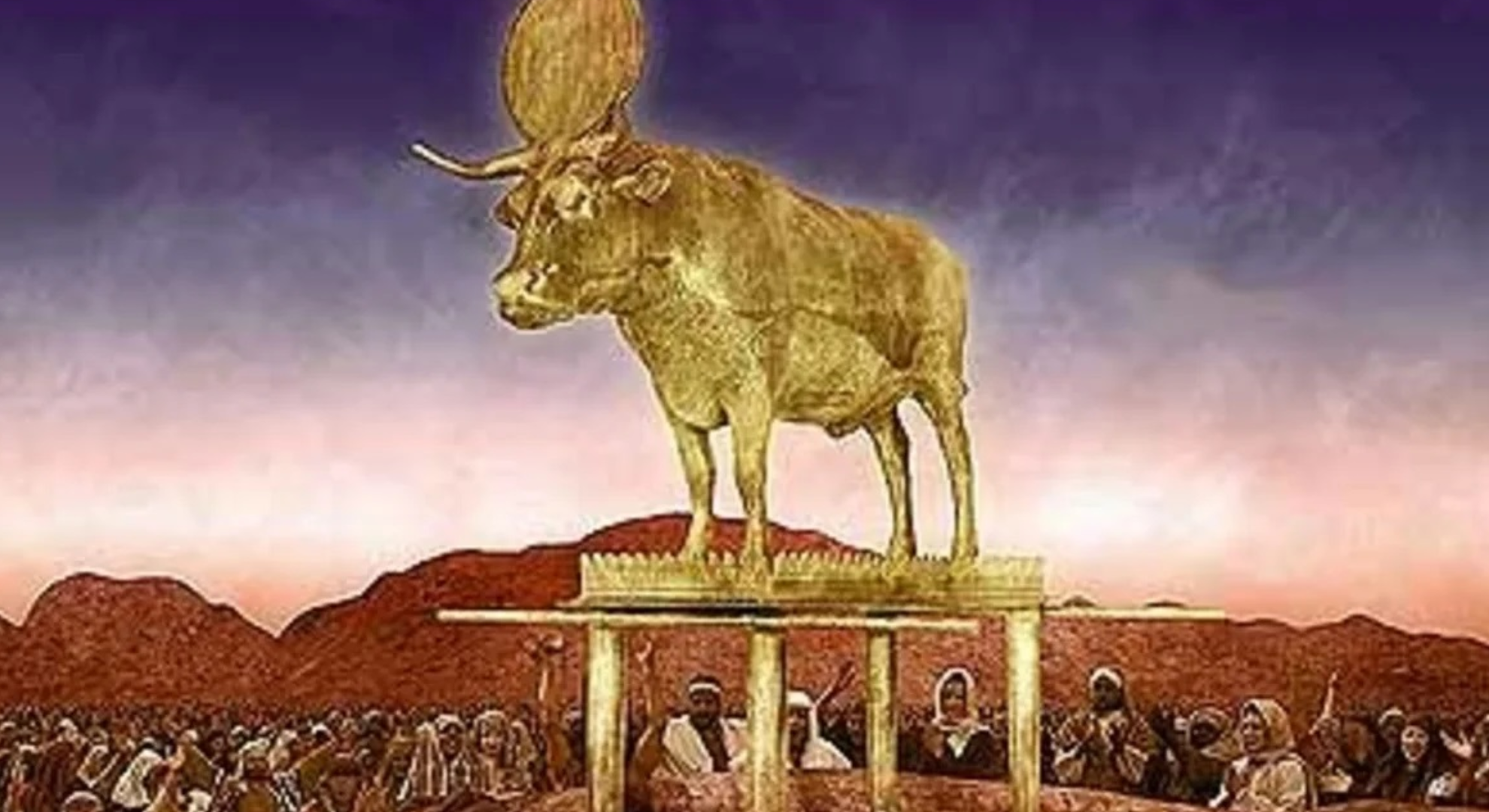
We see this, for example, in the golden calf worship of the northern kingdom of Israel. The golden calf was intended to be a representation of Yahweh (or another god or gods who brought Israel out of Egypt), despite the Israelites’ earlier creation of a golden calf that was condemned by God. The works of God were attributed to this calf, such that Israel redirected its worship of the true and the living God to an idol. Nevertheless, despite this reassignment of attributes from one god to another, the prophets God sent to the northern kingdom were still able to speak to its kings and people about their relationship with him.
The woman at the well might offer a clearer example. She was part of the Samaritan religion, which descended and departed significantly from biblical Judaism. Like the northern kingdom, instead of worshiping at the temple that God prescribed, the Samaritans worshiped at a different place, and with a significant lack of knowledge concerning the true and the living God. Yet Jesus regarded it as true worship grounded in false knowledge. He said,
“Woman, believe me, the hour is coming when neither on this mountain nor in Jerusalem will you worship the Father. You worship what you do not know; we worship what we know, for salvation is from the Jews. But the hour is coming, and is now here, when the true worshipers will worship the Father in spirit and truth, for the Father is seeking such people to worship him.” (Jhn 4:21-23)
Paul made a similar claim about the Gentiles worship of God, that they did worship the true God (among many idols), but did so without knowledge. He then presented to the Gentiles the truth about this God, as revealed in his word to the Jews.
So Paul, standing in the midst of the Areopagus, said: “Men of Athens, I perceive that in every way you are very religious. For as I passed along and observed the objects of your worship, I found also an altar with this inscription: ‘To the unknown god.’ What therefore you worship as unknown, this I proclaim to you.
“The God who made the world and everything in it, being Lord of heaven and earth, does not live in temples made by man, nor is he served by human hands, as though he needed anything, since he himself gives to all mankind life and breath and everything. And he made from one man every nation of mankind to live on all the face of the earth, having determined allotted periods and the boundaries of their dwelling place, that they should seek God, and perhaps feel their way toward him and find him. Yet he is actually not far from each one of us, for ‘In him we live and move and have our being’; as even some of your own poets have said, ‘For we are indeed his offspring.’
Being then God’s offspring, we ought not to think that the divine being is like gold or silver or stone, an image formed by the art and imagination of man. The times of ignorance God overlooked, but now he commands all people everywhere to repent, because he has fixed a day on which he will judge the world in righteousness by a man whom he has appointed; and of this he has given assurance to all by raising him from the dead.” (Act 17:22-31)
The point is that theological precision about the nature of God isn’t necessary to interact with him. Without question, the Samaritans and the Gentiles had many problems, but they were still able to interact with the God of Heaven, in distinction from other idols, without clear information about his nature, or even his past works. God can be clearly perceived and known, even independent of biblical revelation, because each and every human has enough of the divine image to recognize and acknowledge the God who created him (Rom 1:19-20).
We have a relationship with God that exists regardless of a clear and accurate understanding of his nature. So while God will helpfully identify himself as “the God of Abraham, Isaac, and Jacob,” or “the God who delivered you out of Egypt,” these identifying marks are an aid to the exist testimony that we all have about the one true God who created us. We can suppress that testimony, lie about him, and turn to other gods. Or like the Samaritans, we can misunderstand the true God and worship him in wrong ways. But none of that prevents us from dialoguing about God with people who have greater knowledge than us.
So if by “God” a trinitarian and patternist both mean the God who created the universe, rather than some lesser deity competing with others in a pantheon, we can dialogue about that God and debate his attributes without necessarily speaking of different gods. We’ll disagree at places, and perhaps may legitimately be seen as having different religions. But the subject of the discussion is still the same person, because we’re both debating about the God of the Bible. So the analogy fails, because whatever may be said about the divine attributes we derive from scripture, the person in view is still the God of Abraham, Isaac, and Jacob, the God who delivered Israel from Egypt, and the God who delivered the Christian from the bondage of sin through Jesus’ sacrifice on the cross.